Excerpted from Chop Chop by Ozoz Sokoh. Copyright © 2025 by Ozoz Sokoh. Photographs copyright ©2025 by James Ransom. Published by Appetite by Random House®, a division of Penguin Random House Canada Limited. Reproduced by arrangement with the Publisher. All rights reserved.
Ingredients
For the Chop
- 6 cups cooked white rice
- 1 recipe hot groundnut stew (recipe follows)
For the Toppings
- 2 hard-boiled eggs, peeled
- and sliced
- ½ avocado, sliced
- 2 tablespoons dòdò (recipe follows)
- 2 tablespoons chopped fresh cilantro
- 1 tablespoon roasted groundnuts
- 1 tablespoon chopped fresh tomatoes
- 1 tablespoon minced green bell pepper
- 1 tablespoon ripe papaya chunks
- 1 tablespoon pickled onion
For the Groundnut Stew
- 4 cups (about 1 L) Curry Stock
- 3 ½ teaspoons fine sea salt, plus more as needed
- 2 tablespoons grated fresh ginger
- 1 tablespoon minced garlic ½ teaspoon dried thyme
- ½ teaspoon freshly ground black pepper
- 1 pound (about 450 g) boneless or bone-in chicken thighs, cut into 2-inch (5 cm) pieces
- 1-pound (about 450 g) boneless or bone-in beef chuck, cut into 2-inch (5 cm) pieces
- 3 medium red onions: 2 coarsely chopped, 1 sliced
- 2 large red Roma (plum) tomatoes
- ½ cup (120 ml) groundnut oil
- 2 dried bay leaves
- 1 ½ cups (8 ounces/225 g) Roasted groundnuts
- 1 whole Scotch bonnet or habanero pepper, poked 2 or 3 times with a knife
- ½ to 1 teaspoon dry pepper (optional)
For the Dodo
- 4 ripe plantains, yellow with black spots (about 2 pounds/900 g total), rinsed
- 1 ½ teaspoons fine sea salt
- Neutral oil, for frying
Directions
For the Groundnut Chop
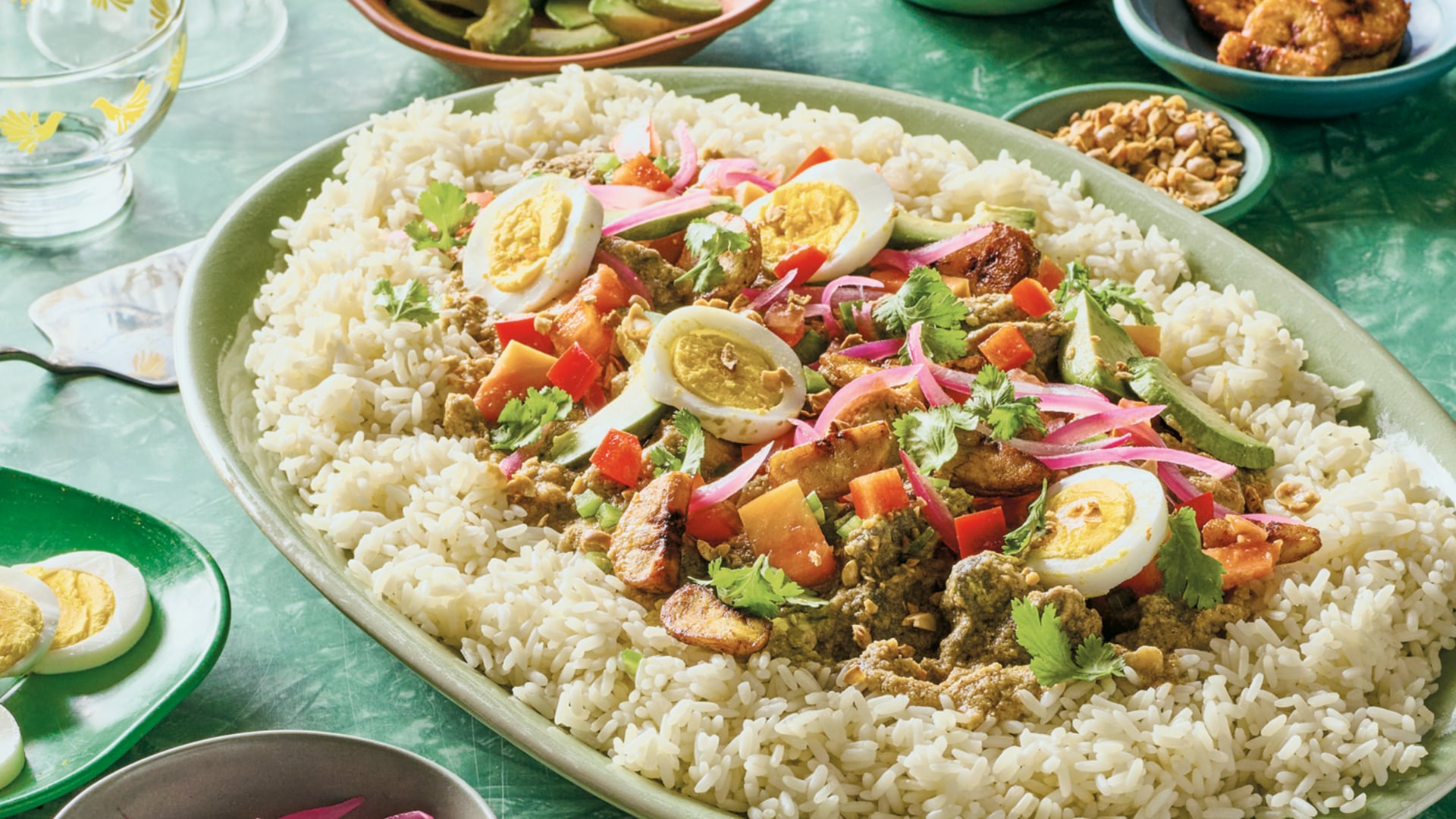
- Spoon the rice onto a large platter, spreading it so it is 2 inches (5 cm) high. Gently make a shallow well at the center.
- Fill the center with 2 or 3 spoonfuls of stew, leaving a 2- to 3-inch (5 to 7.5 cm) margin of rice around it. Spoon or scatter some of the toppings over the rice and stew—just enough to add color and texture.
- Serve with a cake slicer or fish spatula, spooning some onto each plate and letting your guests pick the toppings.
For the Groundnut Stew
- In a large bowl or container, combine the curry stock and 1 cup(240 ml) water to thin the stock (you should have 5 cups/about1.2 L thinned stock). Set aside.
- In a separate large bowl, combine 3 teaspoons of the salt, the ginger, garlic, thyme, and black pepper.
- Add the chicken and beef and rub it well so the meat is seasoned properly. Set aside.
- In a blender, combine the chopped onions and the tomatoes with1 cup (240 ml) of the thinned curry stock and blend until smooth; you should have about 3 cups (720 ml) stew base total. Set aside.
- In a large heavy-bottomed pan or Dutch oven, heat 1/4 cup (60 ml) of the groundnut oil over medium heat. When the oil is shimmering, add the chicken and beef. Increase the heat to high and cook, stirring every now and again, until the meat loses color, about 15 minutes.
- With a slotted spoon, transfer the meat to a bowl; cover to keep warm. In the same pan, combine the remaining 1/4 cup (60 ml) groundnut oil, the sliced onion, the remaining ½ teaspoon salt, and the bay leaves and stir. Reduce the heat to medium and cook until the onion softens, about 5 minutes.
- Add the stew base and 2 cups (480 ml) of the thinned stock, stirring and scraping up any browned bits from the bottom of the pan. Increase the heat to high, cover with the lid ajar, and cook until just reduced, 20 to 25 minutes.
- Meanwhile, in a blender, combine the peanuts with 1 cup (240 ml)of the thinned stock. Blend on high until creamy (a touch of grit is okay); you should have about 2 cups (480 ml). Transfer to a bowl. When the stew has reduced, carefully transfer 1 cup (240 ml) of the stew to the peanut paste and stir until well combined. Add this mixture to the pot with the stew and stir well. Cook for about 5 minutes, then return the meat to the pot. Add the remaining 1 cup (240 ml) thinned stock and the Scotch bonnet and stir well.
- Reduce the heat to low, cover with the lid ajar, and cook, stirring often, until the meat is soft and tender, and oil pools around the sides and on top, 25 to 30 minutes. Taste and adjust with more salt, if needed. If you want more heat, add some dry pepper.
- Remove from the heat and let stand for about 10 minutes; it will thicken. If desired, thin the stew with water. Season as you desire.
For the Dodo
- On a cutting board, use a sharp knife to cut off the pointed ends of the plantains. With the tip of the knife, slice into the skin along the length of the plantain without cutting into the flesh. Pry the skin apart and discard it, along with any fibrous strings.
- Cut the plantains as you like: ½-inch (1.3 cm) dice, ⅓-inch-thick (8.5 mm) rounds, or slices on the bias, about 2 inches (5 cm) long and⅓ to ½ inch (8.5 mm to 1.3 cm) thick. Place the pieces in a large bowl, sprinkle with the salt, toss, and gently rub so each piece is salted.
- Preheat the oven to 200°F (95°C). Line a rimmed baking sheet with a wire rack or paper towels.
- Fill a wok or large Dutch oven with 1½ to 2 inches (3.8 to 5 cm) oil; it should come no more than halfway up the vessel. Heat the oil over medium-high heat to 350°F (175°C).
- Carefully add some plantain pieces to the hot oil without overcrowding the pan. Ensure the pieces stay separate; otherwise, they will not cook properly.
- Cook, stirring occasionally until the plantain edges caramelize and begin to brown, then flip the pieces over and cook until golden brown and caramelized all over, 8 to10 minutes.
- With a spider or slotted spoon, transfer the dòdò to the prepared baking sheet and keep warm in the oven. Repeat with the remaining plantains, allowing the oil to return to temperature between batches.
- Serve warm. Leftovers can be refrigerated in an airtight container overnight. Reheat in the microwave, refry, or warm in a moderate oven.